
Strategic & Tactical Governance Frameworks
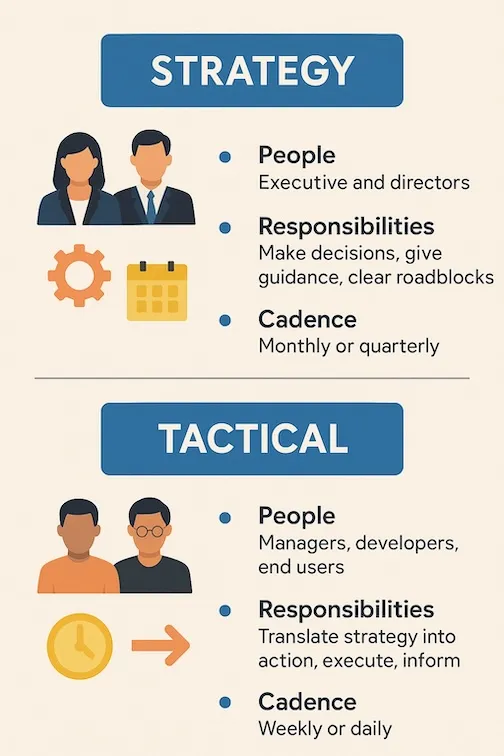
Project Overview: The Strategic & Tactical Governance Frameworks initiative established a unified system to align organizational strategy with day-to-day execution. Strategic governance focused on decision-makers guiding priorities and budgets, while tactical governance engaged hands-on contributors responsible for operational execution and problem solving. The frameworks defined stakeholders, meeting cadences, accountability, and “living” roadmaps to maintain alignment across teams and initiatives.
Objectives
- Define clear strategic and tactical governance structures to improve decision-making and execution across cross-functional teams.
- Identify stakeholders: strategic (decision-makers and guides) and tactical (subject-matter experts and hands-on contributors).
- Establish meeting cadences: monthly or quarterly steering committees for strategic oversight, weekly or daily standups for tactical execution.
- Enable transparent tracking of initiatives, priorities, and budgets using “living” roadmaps.
- Foster alignment between strategic priorities and tactical execution across all teams.
Background
Organizations often struggle to connect high-level strategy with daily execution. Without clear governance frameworks, decision-making can be fragmented, initiatives can be misaligned, and budgets may not be tracked effectively. By implementing structured strategic and tactical governance, leadership and operational teams gained clarity on priorities, responsibilities, and timelines, reducing inefficiencies and improving accountability.
Problem
Before this project, decision-making and operational execution were disconnected. Strategic stakeholders lacked visibility into tactical progress, and tactical teams sometimes operated without clarity on priorities. There was no standardized approach to track initiatives, budgets, or dependencies, resulting in duplicated effort, missed deadlines, and misaligned resources.
Features
-
Strategic Governance
- Engages decision-makers to guide priorities, budgets, and high-level direction.
- Monthly or quarterly steering committees review progress, approve initiatives, and adjust priorities.
- Aligns budget planning with organizational objectives.
-
Tactical Governance
- Involves subject-matter experts and operational teams executing initiatives.
- Weekly (or daily in Agile Scrum) standups track progress, resolve issues, and ensure alignment with strategy.
- Provides hands-on oversight and rapid problem-solving.
-
Stakeholder Identification & Roles
- Strategic: Executives and leaders who guide decisions and approve initiatives.
- Tactical: Operational leads and team members responsible for execution.
- Clearly defined ownership and accountability for all initiatives.
-
Living Roadmaps & Budget Tracking
- Tracks ongoing initiatives, priorities, and dependencies.
- Integrates budget considerations into decision-making.
- Provides transparency across teams for informed decisions.
-
Cross-Functional Alignment & Reporting
- Standardized reporting and dashboards for both strategic and tactical teams.
- Bridges high-level organizational priorities with operational execution.
- Ensures consistent communication and visibility across the organization.
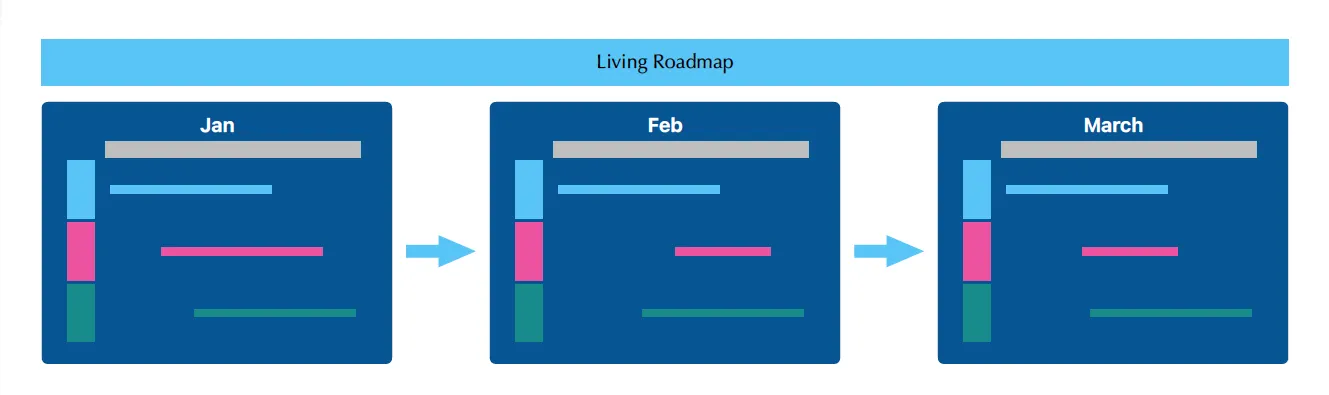 A visual representation of how the roadmap evolves month-to-month, reflecting shifting priorities, updated timelines, and ongoing progress.
Outcome
The governance frameworks created a clear structure connecting strategic priorities with tactical execution. Strategic teams were able to guide decisions effectively, while tactical teams gained clarity on responsibilities and timelines. “Living” roadmaps ensured transparency and budget alignment, improving efficiency, accountability, and cross-functional collaboration across the organization.